Build
Most miniatures require assembly.
Carefully clip the parts from the sprue, clean mould lines, and then use plastic glue to assemble them.
Plastic glue is available from Warhammer, Card Merchant, and Models and Games in Dunedin.
You need clippers to clip parts from the sprue, and a file to clean mould lines.
Prime
Surface primer is a flat neutral paint that adheres to plastic, providing a long-lasting foundation for painting.
Buy brush-on primer by Vallejo or Army Painter at minikiwilandshop.co.nz (search for "surface primer" and look for white or light grey).
If you are priming lots of models at once, it can be easier (but messier) to use spray primer.
You can buy spray-on primer from Bunnings or Mitre 10.
I use Ultra Matte Rustoleum White.
Paint
The standard acrylic paint you might see at craft stores is too thick for tiny models.
Instead, use paints formulated for miniatures, including:
- Citadel Contrast (about $13.50 a pot)
- Vallejo Color Xpress (about $7.50 a bottle)
- Army Painter Speedpaints (about $7.50 a bottle)
There are 7 paints you're likely to need in your toolkit at all times, so buy these first:
- Brown: Leather, wood, dark skin
- Black or Grey: Metal
- White: Cover up mistakes
- Red/Blue/Green: Cloth, lights, flames
- Flesh: Light skin, parchment paper
- Metallic: Silver or bronze or gold, metal highlights
Before painting, think about the colour scheme of your miniature.
Paint in your head first, or colour a drawing in on paper or on a computer, and then use actual paints.
Technique
Paint dries when the moisture from your paint evaporates, so make sure you close your paint bottles and pots tightly.
Try not to get paint in the ferule (the metal part that holds the bristles) of your paint brush.
You don't need a lot of paint on your brush when you're painting a tiny miniature.
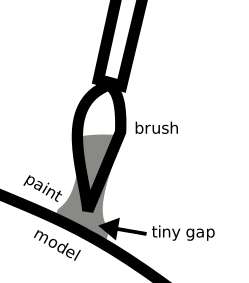
In miniature painting, you use your paint brush as a paint storage device.
You don't want the paint in your brush to get transferred onto the miniature all at once, so your goal is for your brush to barely touch the miniature.
Use surface tension to "pull" the paint off the brush onto the miniature.
Fix mistakes with paint that's the same colour as your primer (usually white).
Use water to clean your brush frequently.
Don't leave your paint brushes resting in water.
You can buy really nice brushes from Hobbyland online.
The Das Roman brush uses natural sable fibre and are very good, especially for the price.
Try sizes 2/0, 0, and 1 for detail work, and size 3 or 4 for covering large areas.
Brushes do wear out over time, but I normally expect to get at least 6 months use out of a brush when I'm painting almost every day, or a full year when not painting often.
Where to buy miniatures
You can buy model kits from Warhammer and Models and Games in Dunedin.
Alternatively, you can buy them online for delivery:
Building terrain
When playing a game with your miniatures, it's nice to have objects (buildings, shipping containers, stone monoliths, and so on) for your characters to hide behind.
You can build terrain out of cardboard, biscuit packaging, plastic bottles, and any clean rubbish you find around your house.
Glue things together, paint them, and see what you can create.
For terrain, it's a good idea to use cheap acrylic paint (save your good paints for your models!).
You can find cheap craft paint at any dollar store, or even at Bunnings.
Playing games
There are lots of games designed for miniatures.
Some of the most popular are Dungeons & Dragons, Warhammer 40,000 and Warhammer: Age of Sigmar.
All of these games have rules that are free to download.
You can play simplified versions of Warhammer using the rules sheet you got from the workshop.
A disadvantage to Warhammer games is that they assume you own Warhammer miniatures.
To play games with other (non-Warhammer) miniatures, try my game Damage Die, which is designed to be simple and quick to play with any collection of miniatures.